
The following was written with two other peers.
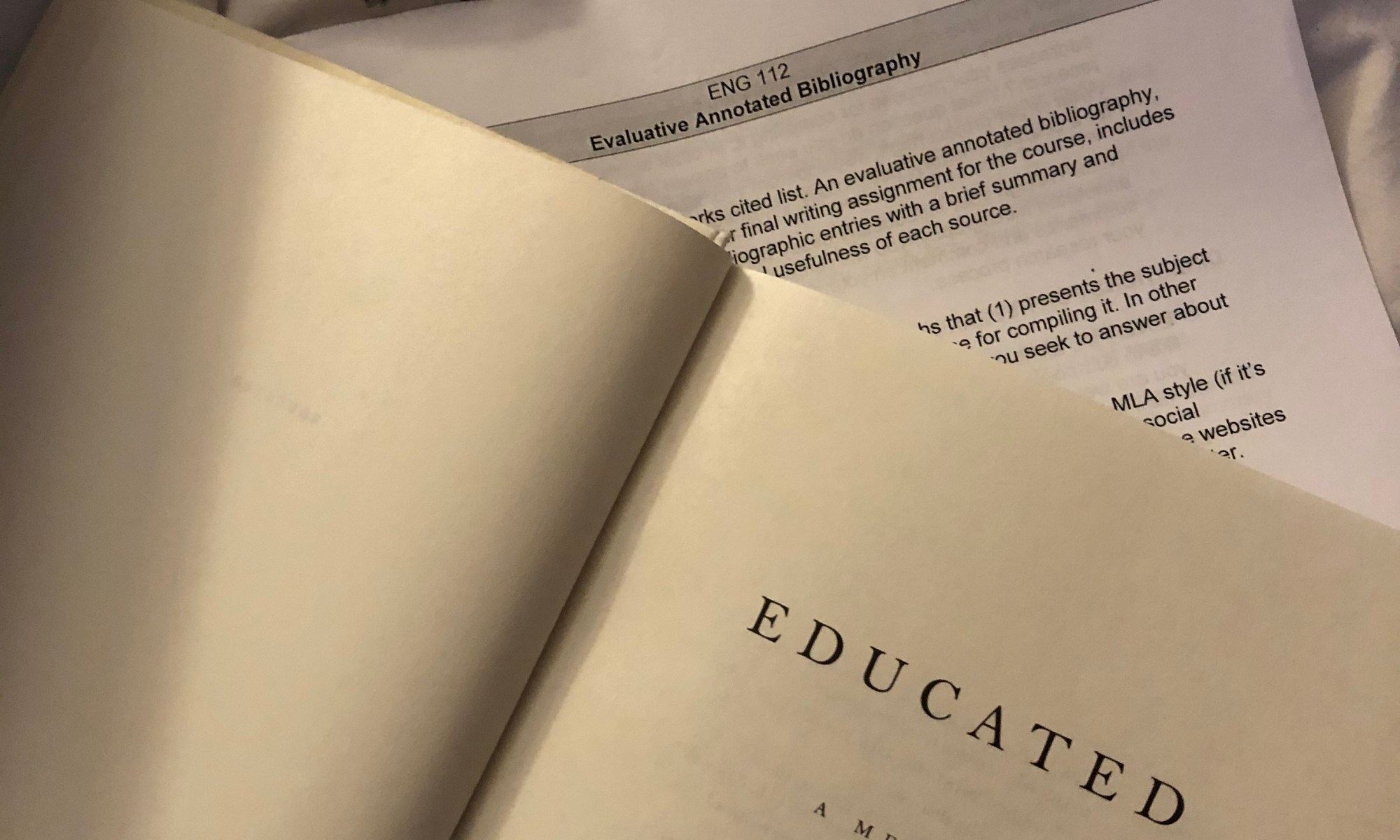
In Educated, we first meet young and sweet Tara Westover, who is being raised by her parents Gene and Faye Westover in the mountains of Idaho. Gene is head of the family of survivalists and also one of the more problematic members of the Westover family. It slowly becomes more obvious from the beginning of the novel that this family is anything but normal but this assumption becomes more apparent when you look into father Gene and Tara’s older brother, Shawn. Throughout the book, both Gene and Shawn show signs of multiple mental disorders consisting of bipolar disorder, short temper/ anger issues, depression, and manic episodes. We chose to do our research on this topic in order to find out more details of the mental illnesses that were not diagnosed or thoroughly discussed, but apparent in members of the Westover family.
Depression and Bipolar Disorder: Your Guide to Recovery by William Marchand describes many moods and depressive disorders and statistics within the research of each disorder. Marchand describes depressive episodes that tie to Gene Westover’s conditions described by his wife Faye; “[Gene] was like a sunflower- he would die in the snow- and that come February he needed to be taken away and planted in the sun” (Westover, pp. 32). This is mentioned briefly and is the only direct conversation that is had about Gene’s conditions by the Westover family. By comparing this brief description to the knowledge gained from Marchand’s book, it is a valid assumption that in this instance Gene Westover is suffering from the seasonal affective disorder, or SAD. Seasonal Affective Disorder is the reoccurrence of depression at the same time every year (Oxford, 1998). To resolve this, Faye plans a trip to Arizona to get Gene into the warmth and out of his “slump”. Trips to Arizona are mentioned multiple times throughout the book letting us know that the depressive episodes are consistent and can be linked to him having SAD.
Bipolar disorder is a common mental illness described as “a group of common, disabling conditions of mood dysregulation” (BMC Psychiatry, 2013). The article “Adaptation to bipolar disorder and perceived risk to children: a survey of parents with bipolar disorder” says that parents who self- identify with BPD are aware that they pose a risk to their children whether that is passing on the mental illness or show a physical threat to their child(ren). In multiple instances throughout Educated, quick mood changes are seen in Gene and Shawn Westover. This is seen more commonly with Shawn Westover when he is interacting with Tara. Shawn is known to quickly turn violent and shut it off immediately after he feels his “damage is done” to Tara. Although this could be caused by previous head injuries, the aggression towards Tara could also be taken in an abusive way as it leads to physical and possible mental injuries in multiple cases. The aggression is not only put towards Tara. Shawn also shows quick changes from a neutral mood to angry when involving his father, Gene. While working in the scrapyard, Gene tries to put Tara in dangerous situations, once involving a shear. Shawn was angry that Gene had put Tara in such a dangerous place to work so he helps her so she is at less of a risk of getting pulled into the shears and injured. At this point you see Shawn being nice to Tara, taking care of her. Whether it is meant in a paternal way or a way of getting leverage on Tara for the future, Shawns helping her spites their father and shows how Shawn’s anger, although not present greatly, is still there and silently fuming. Shawn’s anger always somehow ties back to Tara and Gene. Hinted in one case, Shawn is aggressive towards Tara because he feels as if she is ungrateful and being let off too easily by their parents; “I see you for what you are. You pretend to be saintly and churchish. But I see you. I see how you prance around with Charles like a prostitute” (Westover, pp. 116). Whether this is side effects of Shawn’s head injury or an undiagnosed mental illness, the signs of bipolar disorder and anger issues are well-shown throughout the memoir in both members of the Westover family.
Works Cited
Kernberg, O. F., & Yeomans, F. E. (2013). Borderline personality disorder, bipolar disorder, depression, attention-deficit/hyperactivity disorder, and narcissistic personality disorder: Practical differential diagnosis. Bulletin of the Menninger Clinic, 77(1), 1-22. Doi:http://dx.doi.org/101521bumc20137711
Kernberg and Yeomans’ article offers an incite into a psychiatrist’s job of diagnosing different disorders under pressured circumstances. Diagnosis, treatment, and descriptions of each disorder was explained thoroughly. Often, bipolar disorder is mistaken for other disorders and it can be harder to diagnose. Bipolar disorder has two subcategories, manic and hypomanic. The difference between manic and hypomanic are manic patients may experience visual or auditory hallucinations.
Kernberg and Yeomans state bipolar patients may “…suffer from both manic episodes and major depressive episodes,”. Every time a depression falls on Gene, Faye, Tara’s mother, decides it’s time for a trip to Arizona. Faye claims “[Gene] was like a sunflower–he’d die in the snow–and that come February he needed to be taken away and planted in the sun.” (Westover, pp. 32). A trip to Arizona is mentioned multiple times throughout the book, letting us know Gene falls in and out of depressive episodes throughout the years.
Peay, H. L., Rosenstein, D. L., & Biesecker, B. B. (2013). Adaptation to bipolar disorder and perceived risk to children: A survey of parents with bipolar disorder. BMC Psychiatry, 13, 327. doi:http://dx.doi.org/10.1186/1471-244X-13-327
A survey was conducted on parents diagnosed with bipolar disorder (BPD) to see if/how having BPD affects their child(ren). The results showed children can not only be affected by genetics and be at a higher risk of having BPD but their environment can also influence them. Parents’ mood swings can influence the child(ren) to act in similar ways. Parents also expressed worry over their children that were similar to them, had low mood, mood swings, anxiety, children with attention deficit hyperactivity disorder and poor social skills.
Gene’s behavior not only affects him but, all his children as well. We can see this more specifically in Shawn Westover. Shawn also shows signs of high and low mood swings along with a quick temper. Some of these could be related to his previous head injuries but they most likely stem from him being raised by a bipolar father. Shawn might have genetically inherited his father’s BPD or it is just an effect from the way he was raised.
Abramovitz, M., & MacKay, J. (2012). Bipolar disorder. Retrieved from https://ebookcentral.proquest.com
In chapter 1, bipolar disorder is described as a “mood disorder” and “a brain disease that affects an individual’s thoughts, energy levels, and behavior”. This book helps people learn what bipolar disorder actually is and how it affects a person. It helps them see why people who suffer from this disorder act the way they do. The people that suffer from this disorder can not exactly control the way that they are behaving and do not realize what is happening. The book also describes how a person who suffers from bipolar disorder may also go through manic stages of high energy and lots of happy thoughts. Then switch into negative thoughts and low energy state.
Gene Westover is believed to be suffering from bipolar disorder but has never been medically diagnosed by a medical specialist. In “Educated”, Gene Westover goes through periods where at points Gene is excited and happy feeling towards certain things. At other points, Gene gets ticked off very easy and becomes very agile. Gene does not believe in going to the doctor or being involved in anything that the government is a part of. For that being said, Gene refuses to see a doctor so doctors can not help Gene with the mental illness or any other injuries.
Marchand, W. (2012). Depression and bipolar disorder: Your guide to recovery. Retrieved from https://ebookcentral.proquest.com
Mood disorders are quite common nearly 10% of the population will or have suffered from a mood disorder at some period in their lifetime. But only around 2% of that statistic revolves around bipolar disorder. There is a total of three subtitles of bipolar disorder. Bipolar I disorder is when a patient has had at least one episode going from happy to sad or either sad to happy without any control. Bipolar II disorder is when a patient has had one or more of very depressed episodes or very happy episodes but no mixed episodes like bipolar I disorder. The third type is bipolar disorder not specified which is where a patient has episodes of emotions but does not fit into any of the other two types of bipolar disorders.
Gene Westover is part of the 2% of the population that suffers from the mental disorder that affects the emotional well-being of the patient. Westover shifts from many phases of enjoyment and happiness to a sudden switch to depressed and mad due to a little inconvenience. Westover has many more mad and depressed outbursts than the happy and excited so the diagnosis from the book analysis may be criteria number three. Gene Westover does not fit into either category I or II due to the number of episodes and emotions that Gene encounters during them. Westover goes into manic episodes when inconveniences encounter his mindset like when Shawn got hurt on the shears and Gene’s wife was very upset because Tara was told to take over with the dangerous equipment.
 Britton's Blogging Blog